See your facility’s transfer workload
Create requests, review priorities, offer work to approved EMS partners, and follow accepted transfers through dispatch, transport, and completion.
FOR HOSPITALS & EMS AGENCIES
A patient needs to move. Your teams need a shared plan. Transfers Health brings hospital transfer requests and EMS pickup commitments into one workspace, so both sides can see the work ahead and what happens next.
Built for emergent and non-emergency ambulance transfer coordination, from the hospital floor to the EMS dispatch desk. Authorized staff choose clinical priority and transport requirements.
Early MVP Available for synthetic-data evaluation. Not ready for clinical use.
A CLEARER HANDOFF
Transfer coordination crosses organizational boundaries. Transfers Health gives each team a view of the work it is authorized to see, with a common record of requirements, pickup commitments, and changes.
Create requests, review priorities, offer work to approved EMS partners, and follow accepted transfers through dispatch, transport, and completion.
Review transport requirements, accept with a promised pickup time or decline, and keep the hospital informed as an assigned transfer progresses.
Use a durable organization inbox and a permission-controlled audit trail. Accepted requests changed by the hospital need EMS confirmation before dispatch.
FROM REQUEST TO COMPLETION
A hospital and EMS agency each approve their own side of the partnership before the hospital can offer transfers.
Hospital staff select pickup, destination, requested time, priority, ALS or BLS, IV support, and equipment such as a monitor, ventilator, or infusion pump.
The hospital offers the request to approved agencies. One agency accepts and commits a pickup time; competing offers are withdrawn.
The assigned agency records dispatch, transport, and completion. Both teams can review their authorized transfer history.
INSIDE TRANSFERS HEALTH
These screenshots show the actual shared application components with synthetic demonstration data. All organizations, patient labels, and locations shown are fictional. Select a screenshot to open the full-size image.
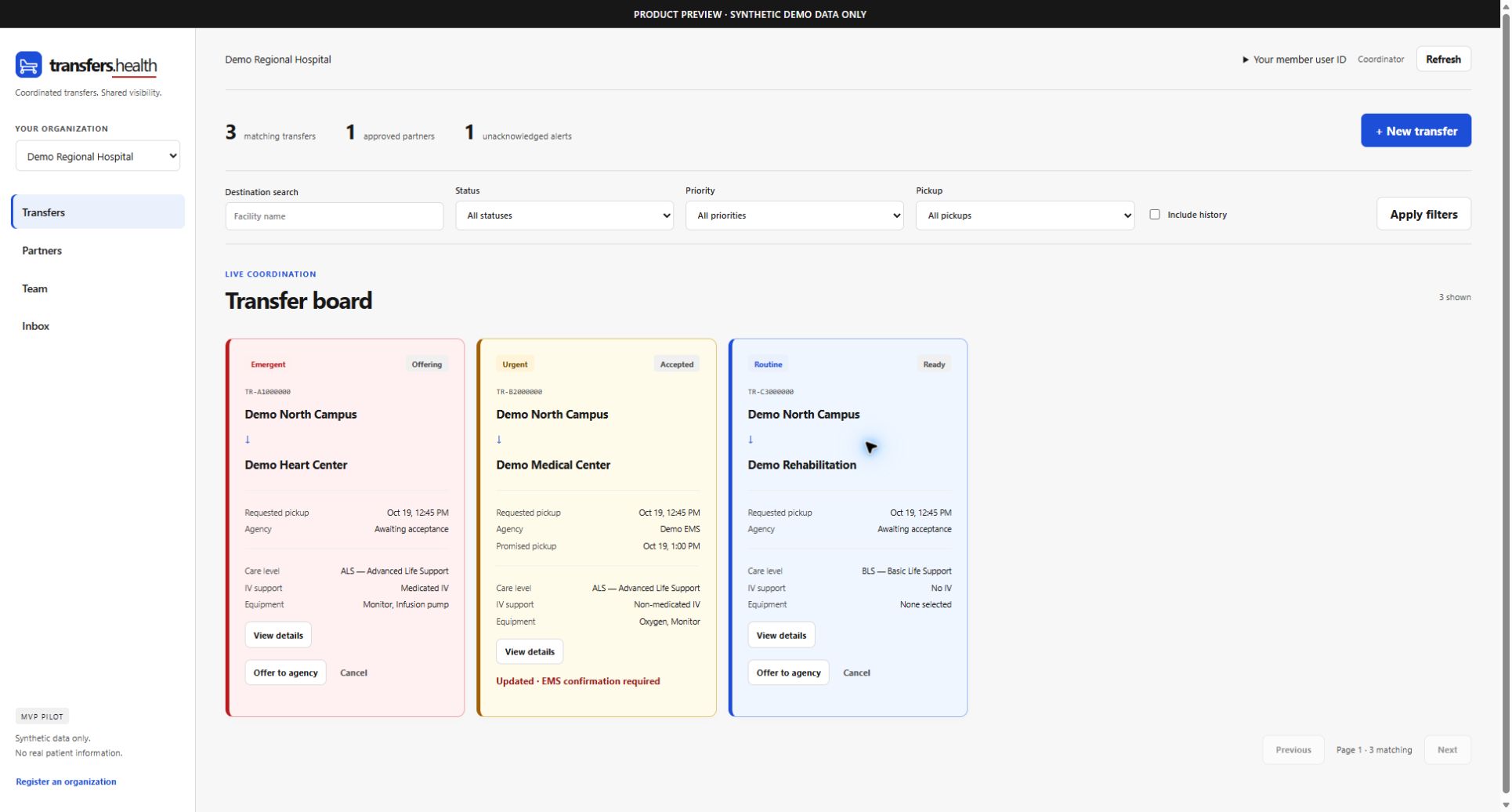
Priority colors and labels make routine, urgent, and emergent requests easy to distinguish. See requested and promised pickup times, assignment, care level, IV support, and equipment. Filter by destination, status, priority, or pickup, and include history when needed.
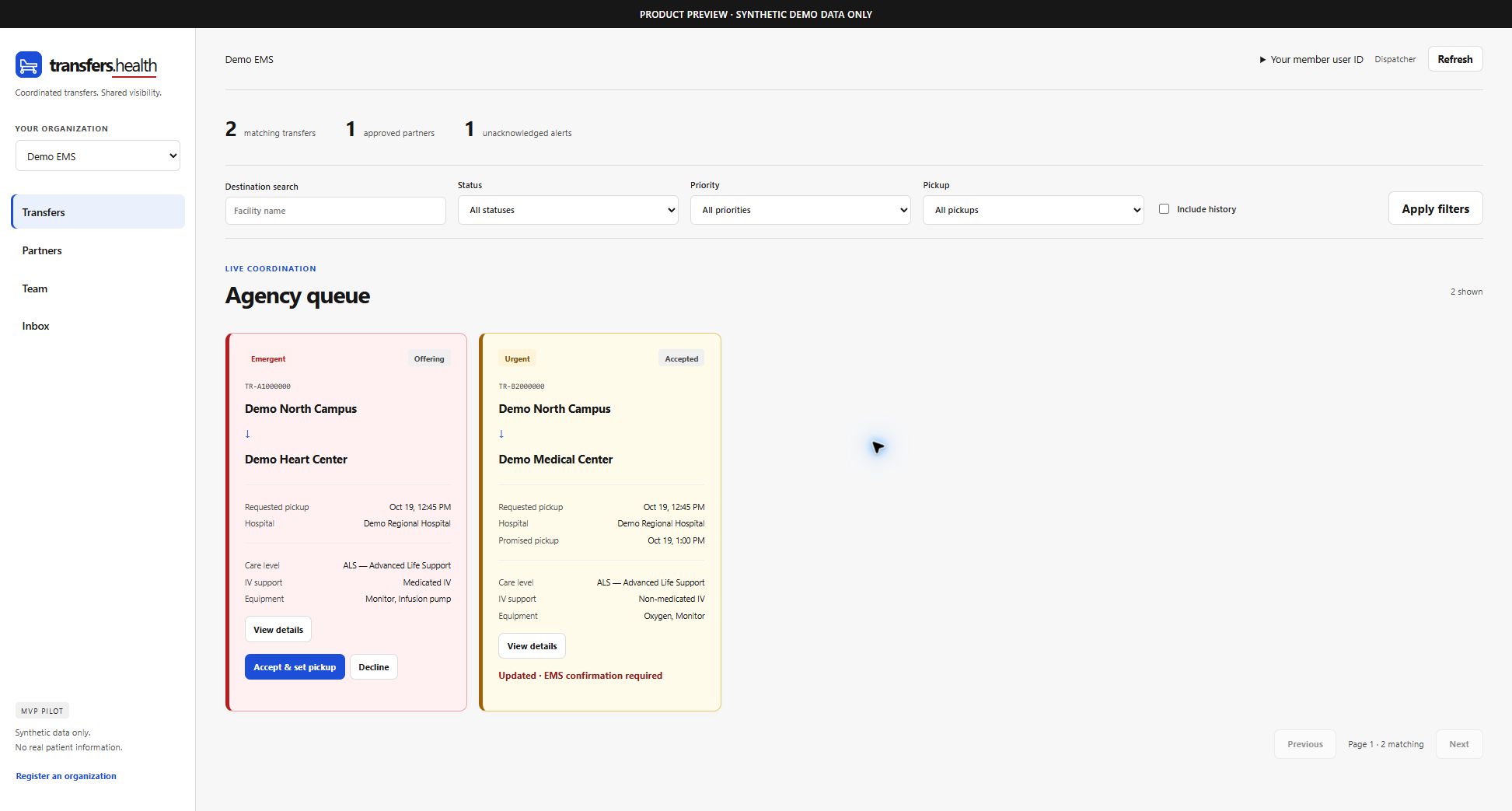
Approved partnerships do not reveal every hospital transfer. Agencies see explicitly offered or assigned work. Review an offer, accept with a pickup commitment, or decline. Hospital changes to accepted work are flagged for review before dispatch.
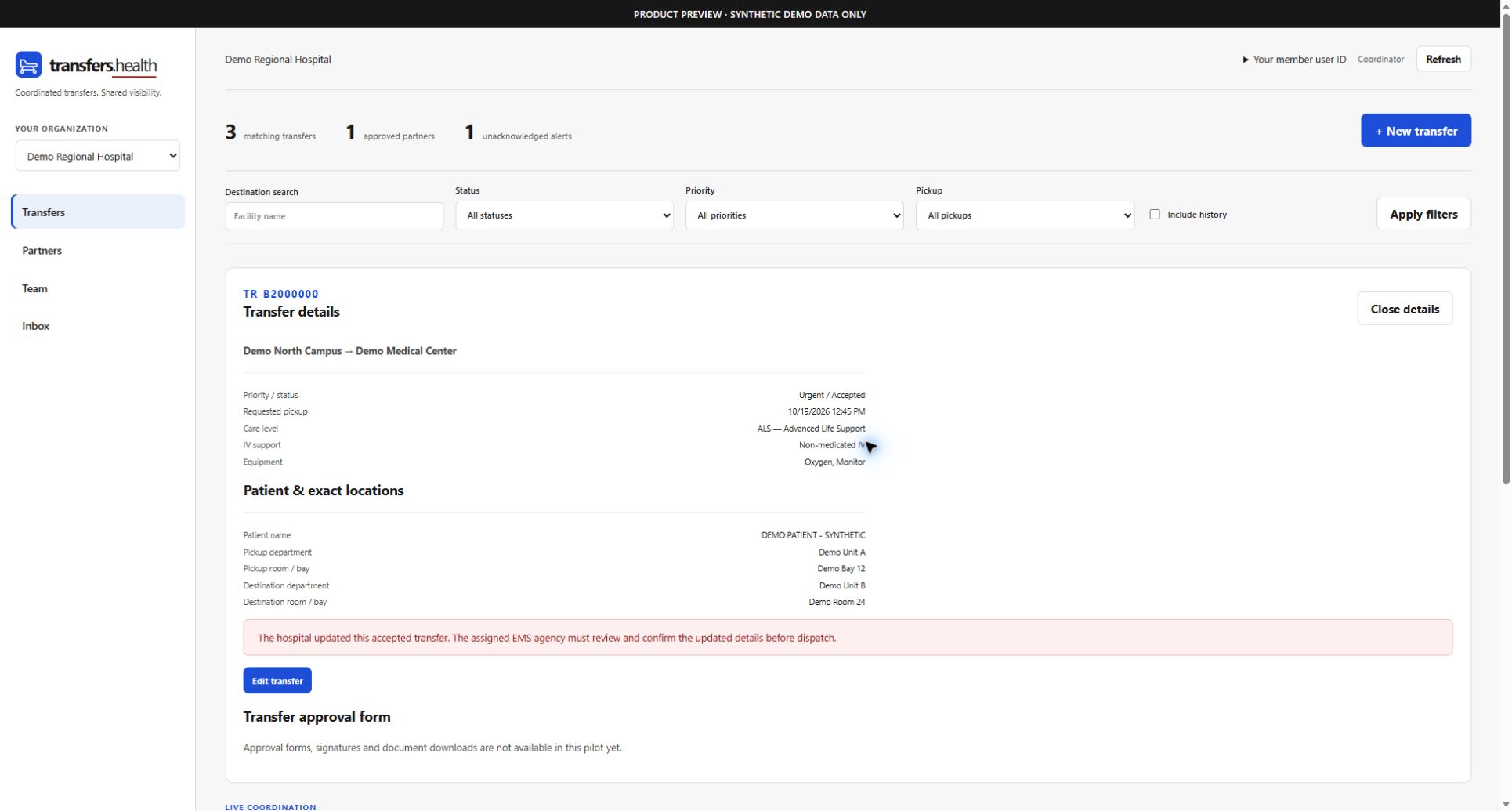
Authorized hospital staff and the assigned agency can see the patient name and exact pickup and destination locations. Hospitals can edit before dispatch. Audit access is restricted, with patient-name and room values omitted from change descriptions.
SHARED WORK. SCOPED ACCESS.
Organization membership, employee roles, facility access, mutual partnership approval for each pickup facility, and the individual transfer determine what a person can see or change. An EMS partnership alone does not grant access to patient names or exact locations.
Patient details stay out of board summaries. Sensitive detail views are audited, and authorized Administrators and Auditors can review the audit trail within their scope. Platform onboarding access does not automatically grant clinical access.
Recorded status timelines and pickup warnings help teams follow progress. Hospitals can review a delayed EMS promise against their allowed pickup window and select another approved agency before dispatch.